
Platform comparison · 2026
An all in one marketing platform or a stack of point tools?
The real choice is not feature count. It is whether your growth work needs one shared context from diagnosis to shipped change, or deeper specialist software for one repeatable job.
By Tin Computer · Published July 23, 2026 · Updated July 23, 2026
Free five-step scan · No card · See it run on your site
Choose an all in one marketing platform when your bottleneck is coordinating evidence and shipping work across several growth jobs. Choose point tools when one channel is already the clear priority and specialist depth matters more than shared context. Tin Computer fits the first case: it keeps the site, product, analytics, search, and work queue connected, while consequential actions remain under founder control.
A fragmented stack can look efficient because every product is excellent at one task. The hidden cost appears between those products. Someone still has to decide which signal matters, move context from a dashboard into a brief, turn that brief into a site or product change, check the result, and update the next priority. For a lean team, that coordinator is usually the founder.
An all-in-one system trades some specialist depth for continuity. The useful version does not merely collect more features behind one login. It preserves the reason a task exists, the evidence behind it, the approval boundary, the implementation, and the follow-up measurement. That is the standard used in this comparison.
Short answer
Consolidate coordination, not every capability. Keep a specialist tool when it owns a high-volume or technically deep workflow. Use one shared execution layer when the expensive part is deciding, handing off, and finishing work across the stack.
How they compare
| Decision | Tin Computer | Fragmented point tools |
|---|---|---|
| Operating center | One project, goal, work queue, and evidence trail | A separate workspace and data model for each job |
| Prioritization | Compares signals before choosing the next bounded task | Each tool optimizes the job it was bought to perform |
| Website and product work | Can turn a finding into a reviewable code change | Often produces a draft, alert, export, or workflow handoff |
| Context transfer | Keeps the reason, source, implementation, and result together | Usually depends on the team to move context between tools |
| Approval and control | Public, risky, spend, and customer actions stay behind explicit approval | Permissions and approvals are configured tool by tool |
| Specialist depth | Broad execution across bounded growth work | Often deeper for one channel, dataset, or production workflow |
| Best fit | Lean teams with a cross-functional backlog that is not shipping | Teams with a known bottleneck and an owner for each handoff |
This compares operating models, not the number of features on a pricing page.
Point tools win when one specialist job is already the growth engine. A dedicated CRM can be the right system of record for a sales organization. A lifecycle platform can be the right center for a mature email program. A large keyword or backlink database can give an SEO team depth it uses every day. An integration builder can be better for deterministic workflows across many applications. Tin Computer is a better fit only when the repeated problem is deciding and shipping growth work across those boundaries, not when the team needs to replace every specialist capability.
The cost of point tools lives in the handoffs
Tool costs are visible. Coordination costs are not. A search platform can reveal a page opportunity, an analytics product can show the drop-off, a writing tool can draft copy, and a project manager can hold the ticket. None of those products necessarily owns the final change. The founder or team still has to reconcile the evidence, decide what is safe to claim, find the right part of the site, get the change reviewed, and return later to measure it.
That model works when the company has specialists who own each step. It breaks down when the same founder is the researcher, editor, product manager, and release coordinator. The work is not blocked by missing software. It is blocked by context switching and by small tasks that never become important enough to deserve a project.
- One dashboard flags the problem, but another system owns the fix.
- A useful draft loses the evidence and claim boundaries that shaped it.
- Channel teams optimize their own metrics without comparing the shared bottleneck.
- Nobody owns the post-release check, so activity is mistaken for progress.
What Tin Computer consolidates
Tin Computer consolidates the operating loop around growth work. It can read the live site, repository, goals, connected analytics, search evidence, support signals, and the current task queue. It then narrows that evidence into a bounded job. For website or product changes, the result can be a reviewable pull request rather than another recommendation waiting for implementation. See the shared-context operating model
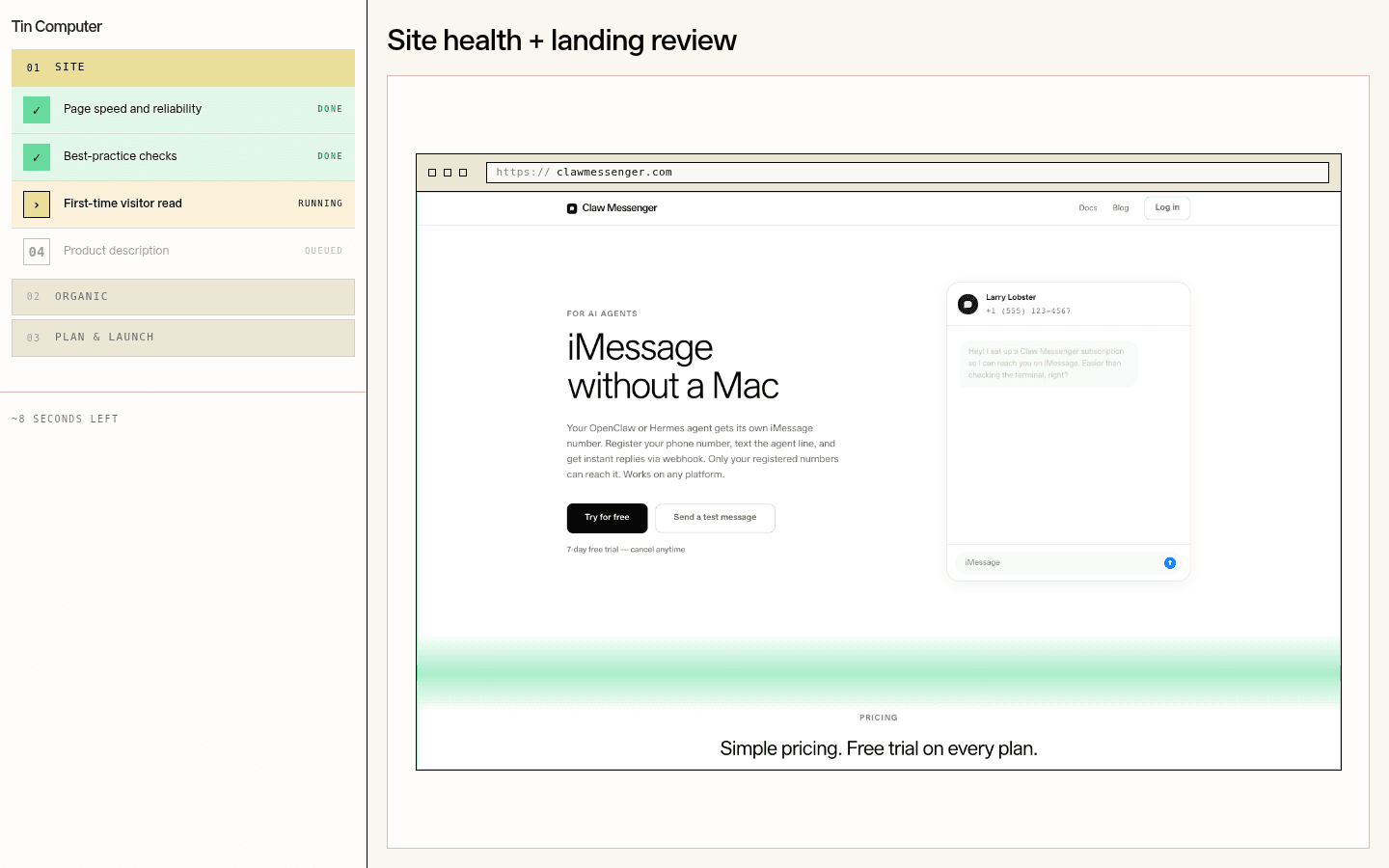
The consolidation has a boundary. It does not mean every external system disappears. Search Console can remain the source for Google search performance. PostHog can remain the product-behavior source. GitHub can remain the review layer for code. A CRM can remain the customer record. Tin's role is to use the relevant evidence, preserve the task context, complete the authorized work, and report what changed.
What should stay specialized
Do not remove a specialist tool because consolidation sounds simpler. Keep it when the tool owns proprietary data, a high-volume operational workflow, or controls your team's daily work. A company running complex lifecycle programs may need a dedicated messaging platform. A sales organization may need a mature CRM. A performance team may need channel-native campaign controls and reporting. Those tools can remain evidence sources and execution surfaces inside a broader operating system.
The test is ownership. If a specialist product reliably takes one recurring job from input to measurable outcome, it is earning its place. If it creates another dashboard, draft, or alert that the founder must translate into a different system, the stack has added a handoff instead of removing work.
How to choose without rebuilding your stack
Use one real cross-functional task as the trial. Start with a live problem, such as a commercial page with impressions but no qualified action. Record how many systems and people are needed to move from evidence to a shipped change. Then check whether the result is attributable and whether the next action becomes clearer. This reveals operating fit faster than comparing feature grids.
A seven-part consolidation test
Score the current stack and the proposed platform on the same representative task.
- Can it read the source evidence without a manual export?
- Does it compare this job with other current growth priorities?
- Does the task retain its rationale and claim boundaries?
- Can the system produce the finished, reviewable change?
- Are public, risky, customer, and spend actions clearly gated?
- Can the result be measured from the original source?
- Does the next priority update without another planning meeting?
If the point-tool stack wins this test, keep it. If the task stalls in the handoffs, add a shared execution layer before buying another specialist product. The goal is not fewer logos on a diagram. It is less unfinished growth work.
Frequently asked questions
- What is an all in one marketing platform?
- An all in one marketing platform brings several marketing jobs into one operating system. The useful test is not whether the feature list is long. It is whether evidence, priorities, execution, approvals, and measurement remain connected from the first signal to the finished result.
- Is an all in one marketing platform better than point tools?
- It is better when coordination is the bottleneck. Point tools are better when one specialist workflow is already the priority and a team member owns the inputs, outputs, and handoffs. The right answer depends on where work currently stops.
- What are point solutions in marketing?
- Point solutions are products built around one defined marketing job, such as CRM, lifecycle email, keyword research, content production, attribution, or app integration. They can offer more depth than a broad platform, but the team may need to connect their data and workflows.
- Can Tin Computer replace my entire marketing stack?
- No. Tin can replace substantial coordination and execution work, but specialist systems can remain valuable sources and operating surfaces. Keep tools that own proprietary data, high-volume workflows, or a recurring job your team already runs well.
- What does Tin Computer replace?
- Tin is designed to reduce the manual loop between finding a growth problem and shipping the authorized response. It can combine project context, choose bounded work, prepare or implement changes, preserve approval gates, and return to the evidence after release.
- When should a small business consolidate marketing tools?
- Consolidate when the founder spends more time moving context, recreating briefs, and coordinating handoffs than completing the work. Do not consolidate a specialist system that reliably owns an important workflow and produces a measurable result.
- How do I compare marketing platforms?
- Test one representative task from live evidence to a finished result. Measure setup time, manual handoffs, review quality, approval clarity, reversibility, and whether the outcome remains attributable to the original source.
- How can I try Tin Computer without replacing my tools?
- Run the free five-step site scan. It shows the work Tin would prioritize using the public site, with no card required. You can judge the diagnosis before connecting a repository, analytics source, or specialist system.
Point it at your site. Watch it ship.
Paste your domain for the free scan. Tin Computer reads your site, finds the work, and starts shipping. No card, cancel anytime.
Claude Code · Codex · Cursor