
Find search problems
Run a technical SEO and AI visibility audit to see where the site needs work. Browse audit workflows
Home/Platform/Autonomous AI agents for marketing that wait for approval
Tin runs autonomous AI agents for scheduled marketing audits, drafts and reports, with public work held for review. We set the agents up on your company's repo and data and run the weekly jobs.
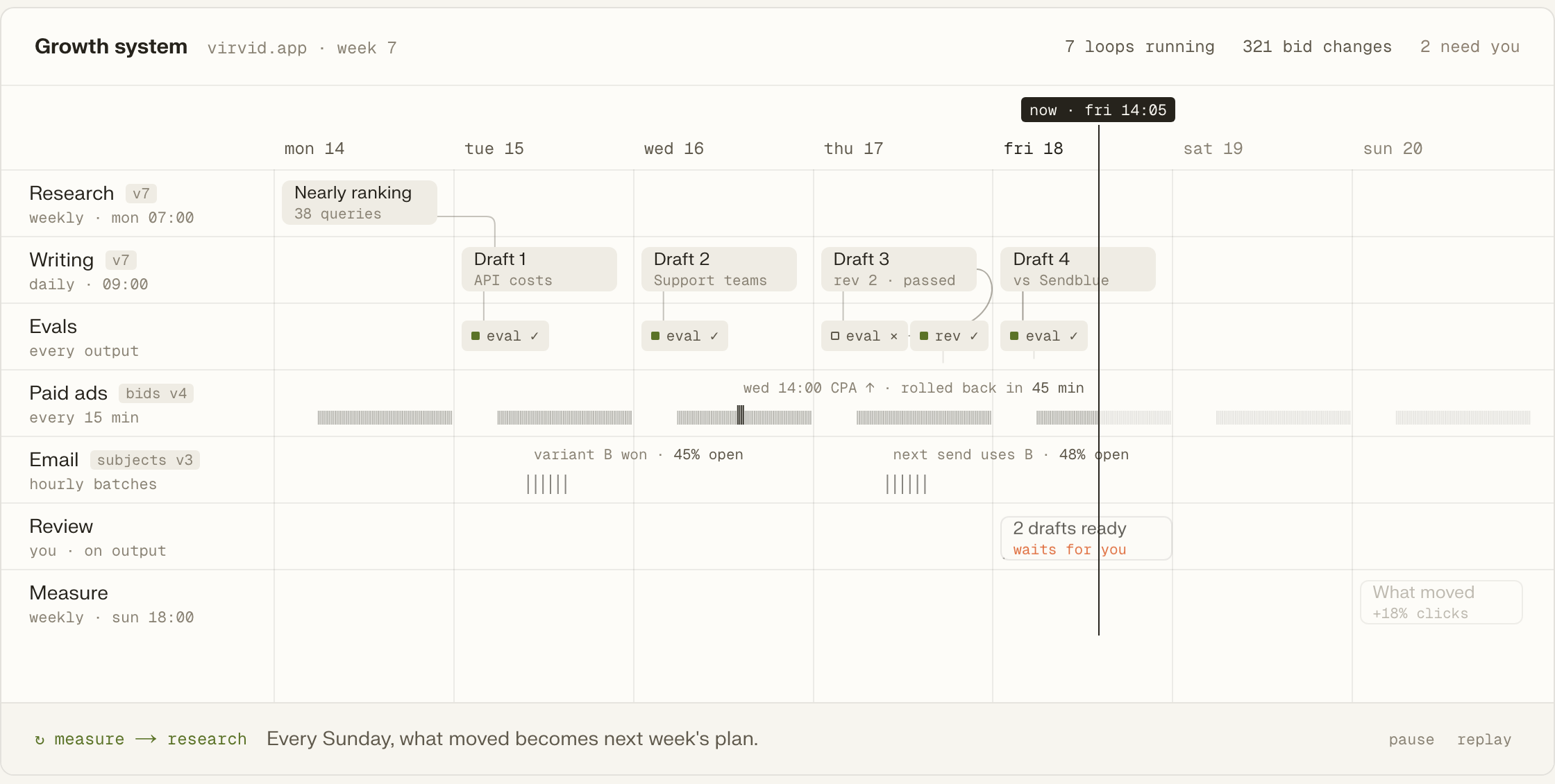
An autonomous AI agent chooses the steps and tools it uses to pursue a goal. Anthropic describes agents as systems whose language models direct their own work and tool use. The agent decides what to do next as it works. n8n describes fully autonomous agents as having an identity and persistent memory, suited to long jobs that need judgment and have no set path.
n8n's fixed workflows define every step beforehand. A coding agent can work in a watched session; Claude Code Docs also describes scheduled runs. n8n's fully autonomous agents act and retain memory between runs. Tin's agents work through scheduled marketing jobs, pausing before public delivery for the owner's decision. For marketing, the useful measure is how much work runs unwatched while you still decide what reaches buyers.
Give an agent a marketing goal and leave it to publish alone, and its mistakes can reach buyers. We learned this while building our fully autonomous agent.
Defined jobs give the agent room to work and a person a draft to check before buyers see it.
Tin starts the saved job, keeps its findings in the project and holds the public action for a decision. Each workflow states its scope.
Tin saves the inputs and schedule with each workflow and handles the timers and retries. A weekly audit or report can start while the team is doing other work. The agent starts from the instructions already saved with that audit or report.
Each workflow declares its inputs, the work it can do and the output it will leave. Read the guardrail to see which actions the job allows. A signup walkthrough uses a Tin-owned test account; an analytics brief makes read-only, bounded queries within a single PostHog project.
The agent leaves a pull request or a draft with a one-click publishing action for the owner to review. Publication waits for approval. The founder approves the important steps, with the draft available to read before that decision. The agent can finish the production work while that public action waits.
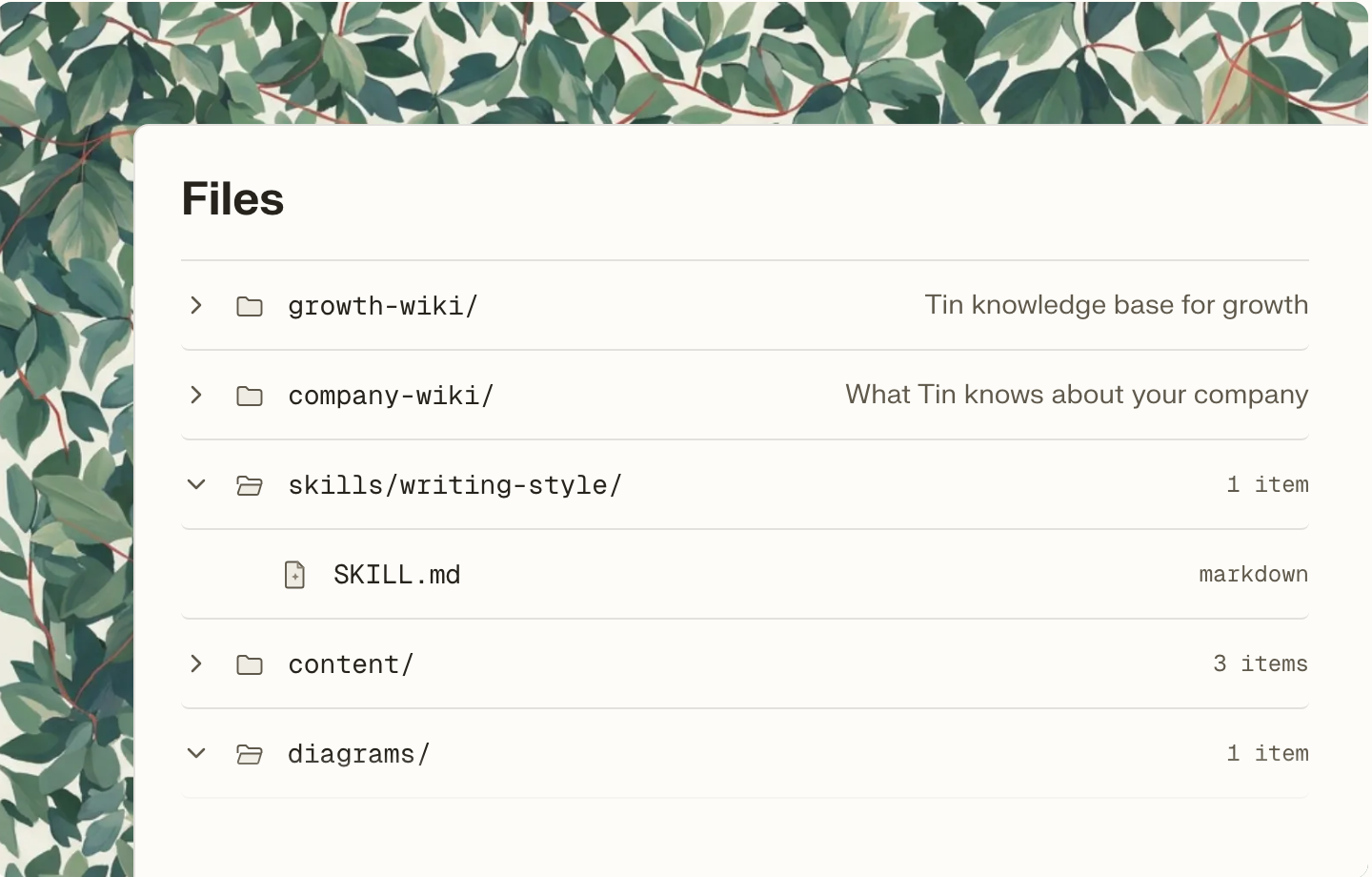
Project memory gathers reports, maps and approved outputs into a wiki that every workflow reads. When an agent starts an article, it can read the findings from the earlier audit. As new runs finish, Tin updates that record so later work can use what the project has learned.
On Sundays, Tin uses the week's activity to prepare the plan for the week ahead. The weekly brief reads the project's activity, files and open items, then proposes what to address next. It is read only: the owner decides which proposals to pursue. The files show what happened, so the next proposal starts from the week's work.
Run a technical SEO and AI visibility audit to see where the site needs work. Browse audit workflows
Use a keyword plan to choose which buyer searches the content should address. Explore keyword planning
Run a content plan, then draft articles in the owner's voice using the project files. Browse writing workflows
Read changes to competitors' pricing and changelogs before deciding what to try next. Explore competitor checks
Build a shortlist from the mailbox, then use it for a paced email campaign. Browse outreach jobs
Run a paid ads assessment or check an existing campaign before choosing the next change. Explore ad workflows
We recommend the marketing-site repository as a lower-risk place to begin. Read the early drafts to judge which jobs are ready to run more often.
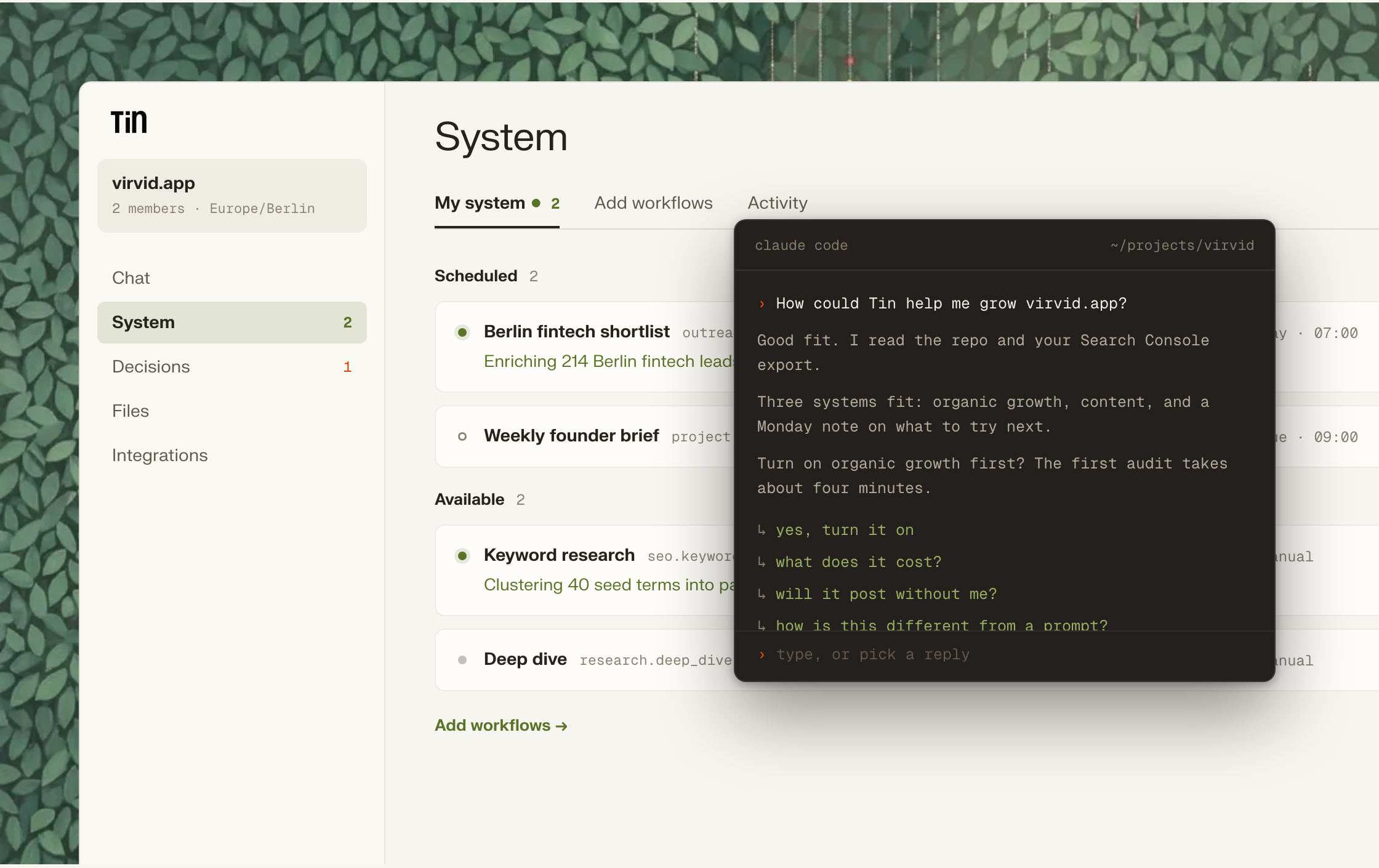
Connect the outward-facing repository through Codex or the browser so the first jobs work on a lower-risk part of the company.
codex mcp add tin --url https://app.tin.computer/mcpPut more jobs on the schedule as their drafts hold up in review and the team learns what to expect.
We choose the marketing jobs, direct the agents and read their output before it reaches buyers.
What each agent does is written as text in the repo.
The agents can run on your machine with your keys and your data.
Change an agent's job by editing its file and sending it back.
Open source, Apache 2.0.
Talk with us about the marketing that keeps slipping behind product work. We choose the agent jobs, configure them on your repo and data, and keep running them with your team.
Agentic AI describes AI that uses tools and works through several steps toward a goal. Autonomy describes how much of that work proceeds without a person. On Tin, a scheduled job sets the task and the agent works through its steps. Read more about the broader term in agentic AI.
People choose the experiments and judge positioning, voice and whether the work serves the company. For a founder's social posts, agents find material and outline ideas; a person writes the post. We still judge whether an agent's output fits the company and which parts need a person to change them.
The agents use your company's accounts and data. Connections include GitHub, Google Search Console, Google Ads, Stripe and PostHog, with reports saved as files in your repository. The accounts, the data and every agent workflow we build remain your company's. Your engineers can open those files when they need to see what the agents have done.
Experienced founders and engineers choose the experiments and direct the agents alongside your team. We have helped 100+ projects grow. We use a weekly call and a shared Slack channel to discuss the jobs in progress and what to continue, change or stop.
Meet the founders and engineers who configure Tin and run the marketing work. We can talk about recurring jobs agents could take first, which need a person and how we would run them for your company.